
AJPS is a peer reviewed journal covering all medical aspects with focus on pharmaceutical disciplines, published quarterly.
AJPS is the official journal of the College of Pharmacy / Mustansiriyah University, publishing high quality clinically oriented submissions which encompass the various disciplines of pharmaceutical and medical sciences.
AJPS is an open access Journal and that mean any user is allowed immediate free access to the works published in the journal and is permitted to read, download, copy, distribute, print, search, or link to the full texts of [the] articles, or use them for any other lawful purpose.
ISSN: 1815-0993
EISSN: 2959-183X
Copyright
AJPS is an open-access scholarly publication that provides complimentary access to all of its content. The articles published in this journal are granted a Creative Commons Attribution International Public License CC BY 4.0 (https://creativecommons.org/licenses/by/4.0/legalcode). This license allows licensees to freely search, download, share, distribute, print, or link to the complete texts of the articles. Additionally, licensees may index the articles for categorization purposes and replicate them in any format, provided that they give proper citation to the author(s). The authors maintain the copyright for their published work on the AJPS website. AJPS, on the other hand, ensures that the authors receive proper credit for their work, which is released under the CC-BY-4.0 license. AJPS allows the author(s) to retain the copyright of their published article.
License
Creative Commons-Attribution (CC BY 4.0) 
Article processing charges (APCs) :
As an open-access journal, publishing an article in this journal requires an Article Processing Charge (APC) that will be billed to the submitting author following acceptance. There are no other fees (for example submission charges, or color charges). The Article Processing Charge for the journal is (125,000ID) (95US$). Payment can be made by Manual Receipt. The journal will not charge for the manuscript until it is accepted for publication and not affect any editorial decisions.
Plagiarism Policy
All manuscripts under review or published with AJPS are subject to screening using Plagiarism Prevention Software Turnitin. Plagiarism is a serious violation of publication ethics. Other violations include duplicate publication, data fabrication and falsification, and improper credit of author contribution. Thus, Plagiarism or Fraudulent or knowingly inaccurate statements constitute unethical behavior are unacceptable, and submitting the same manuscript to more than one journal concurrently constitutes unethical publishing behavior and is unacceptable. It is necessary to mention that AJPS may ignore a duplicated manuscript of up to 20%.
All new submissions to AJPS are screened using https://www.turnitin.com/. Editorial board members may also choose to run a similarity report at any other point during the review process or post-publication. The default similarity report view gives the percentage of the text of the manuscript which has overlap with one or more published articles. Figures and equations cannot be checked at present. Note that a high similarity score does not necessarily indicate plagiarized text. A similarity score of 30% could mean 30% text in common with one source but could equally mean 1% text in common with 30 different sources. Re-used text that has been legitimately cited in the Bibliography may all contribute to the similarity score. It is necessary to mention that AJPS may ignore a duplicated manuscript of up to 20% similarity ratio including the AI usage. It is the responsibility of author(s) to enssure that the similarity index is within the 20% limit till the publication of the article. In the meantime, the AI index must be less than 5%. The subject knowledge of an editorial expert is vital in order to interpret the CrossCheck report and determine whether there are any grounds for concern.
Turnitin Academic integrity tools
The Similarity Report and other Turnitin integrity tools including, AI writing and Authorship.
Turnitin’s AI content checker helps educators, publishers, and researchers identify when an AI writing tool such as ChatGPT or text spinners may have been used in students’ submissions.
https://www.turnitin.com/solutions/topics/ai-writing/
Turnitin's AI writing indicator
Turnitin’s Similarity Score is an exact match to a large body of content for similarity checking, the AI writing score indicates the percentage of text in a document that was likely generated by an AI tool .
https://www.turnitin.com/blog/one-size-does-not-fit-all-interpreting-turnitin-s-ai-writing-score
Current Issue
Vol. 26 No. 3 (2026): Al Mustansiriyah Journal of Pharmaceutical Sciences
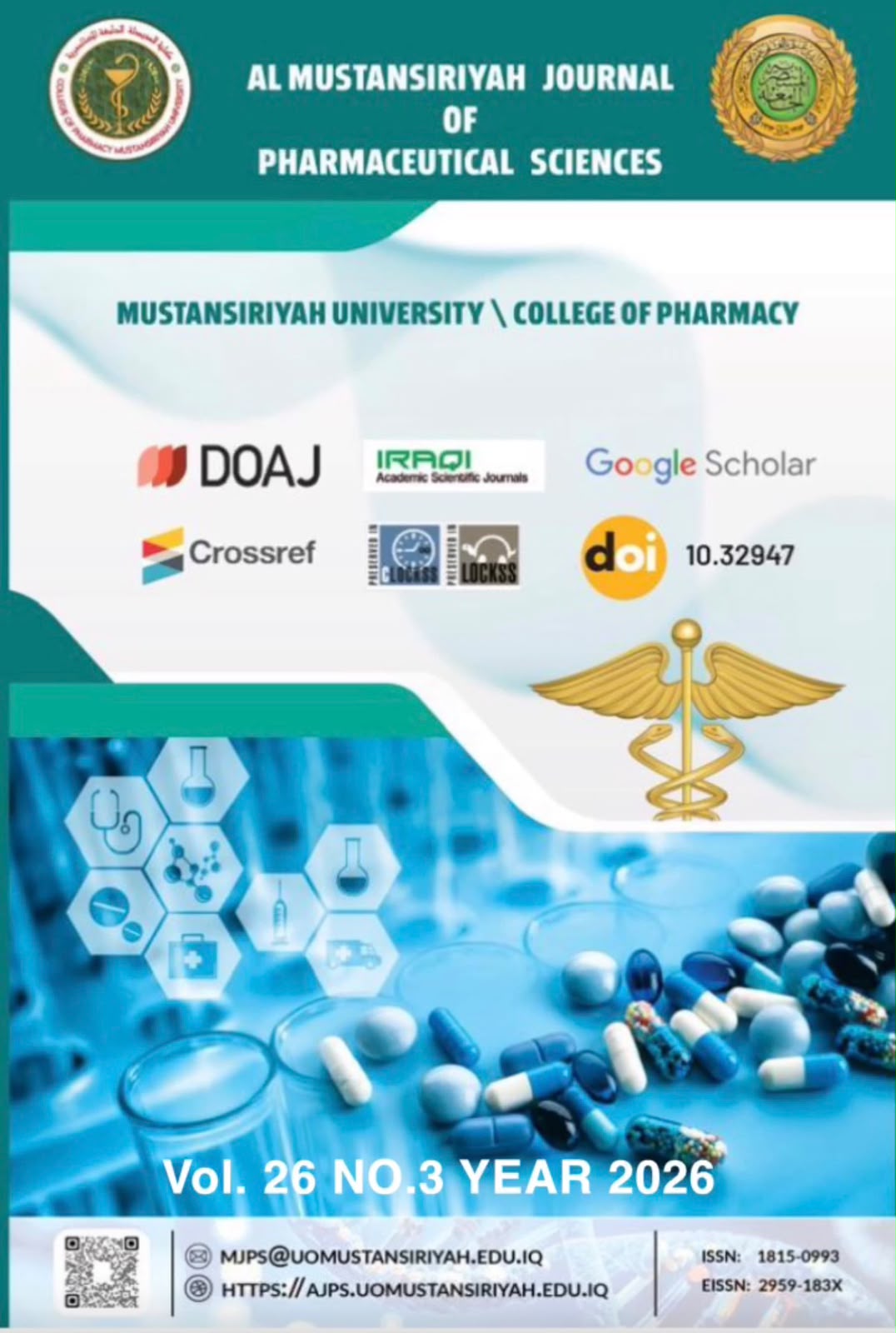
This issue has been available online since 30 Sept , 2026.
all articles are original articles (10) were co-authored by (6) countries (Libya, Jordan, UK, Bangladesh, Malaysia, and Iraq).
Published: 2026-09-30